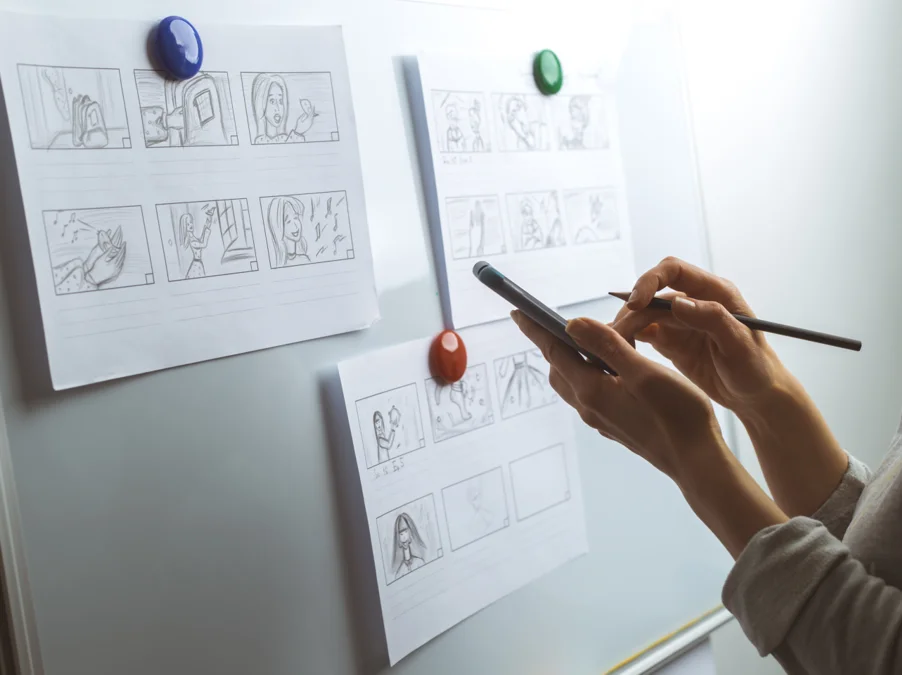
Six core ideas control how a video tells a story: story, emotion, rhythm, structure, juxtaposition, and sound.
Start with story, because everything else supports it.
Story
Story is change.
A character begins in one place and ends in another. The editor’s job is to show that change clearly and make it matter.
The biggest units are acts. Most stories follow three:
- Act 1: Setup. Introduce the character and world.
- Act 2: Confrontation. The character faces problems.
- Act 3: Resolution. The character changes and reaches a new normal.
Two popular models help map this arc.
The Hero’s Journey (12 stages)
- Ordinary World. The hero’s normal life.
- Call to Adventure. A challenge appears.
- Refusal of the Call. The hero hesitates.
- Meeting the Mentor. Guidance or help arrives.
- Crossing the Threshold. The hero enters the unknown.
- Tests, Allies and Enemies. Challenges and relationships form.
- Approach. The hero prepares for the biggest test.
- The Ordeal. The central crisis or death rebirth moment.
- Reward. The hero gains something valuable.
- The Road Back. The return journey begins.
- Resurrection. Final test, often a climax.
- Return with the Elixir. The hero brings change home.
Dan Harmon’s Story Circle (8 steps)
- You. A character is in a zone of comfort.
- Need. But they want something.
- Go. They enter an unfamiliar situation.
- Search. They adapt to it.
- Find. They get what they wanted.
- Take. They pay a heavy price for it.
- Return. They go back to the familiar situation.
- Change. Now capable of change.
Smaller units build the acts:
- Sequences
- Scenes
- Beats
- Shots
- Frames
Scenes have one main purpose: a character wants something right now.
The scene shows small steps toward that want or away from it.
Know a scene has ended when:
- The location changes.
- Significant time passes.
- A key character enters or leaves.
- The emotional balance shifts permanently.
Start scenes late and end them early. Cut in after the boring setup and out on the strongest moment: a powerful look, a sharp line, or an unanswered question.
Beats are the small actions and reactions inside a scene.
Frames matter. One wrong frame can weaken an entire beat.
Montages speed up change. They compress time, show effort, growth, or collapse. A strong montage advances the story the way a good music video tells a short arc.
Emotion
Emotion decides how the audience should feel.
The Kuleshov Effect shows how powerful editing can be. The same neutral face looks hungry, sad, or in love depending on the shot placed before or after it. Meaning comes from the cut itself.
Use these tools to create feeling:
- Juxtaposition of shots
- Visual metaphors (a locked door for feeling trapped)
- Repeating motifs (a recurring color or object tied to an idea)
- Leitmotifs (a musical phrase linked to a character or theme)
Non-diegetic sound (music, score, tones the characters cannot hear) carries most of the emotion.
Diegetic sound (dialogue, footsteps, doors) keeps the world believable.
Bad sound ruins everything, even if the picture looks perfect.
Rhythm
Rhythm controls the speed at which information reaches the viewer.
Fast cuts build energy and tension.
Longer shots create calm, suspense, or reflection.
Variety keeps the pace interesting.
Pay attention to eye trace. Where is the viewer looking at the end of one shot? Place the most important part of the next shot in roughly the same area so the eye flows naturally.
When you must explain something dull, use the Pope in the Pool trick. Pair the information with something visually interesting so the audience stays engaged.
Practical Checklist
- Define the story arc first. Use Hero’s Journey or Harmon’s Circle to map acts and main changes.
- Give every scene a clear objective.
- Start scenes late and end early. Always cut on the strongest beat.
- Use montages to show fast change or passage of time.
- Build emotion with juxtaposition, metaphors, motifs, and non-diegetic sound.
- Control rhythm with eye trace and varied shot lengths.
- Protect sound. Prioritize clean diegetic audio and purposeful non-diegetic layers.
- Let the audience connect the dots. Show two plus two instead of telling four.
- Keep story in first place. Editing exists to serve it.
- Check every cut. Does it move story, emotion, or both?
These six ideas give you direct control over how the final video feels.
Master them and the audience will not notice the editing. They will only feel the story.
About the Author
Written by Neil Huyton. Sheffield-based web developer and creator. I build sites with JavaScript/TypeScript, shoot video, and fly drones. Sharing what I’ve learned along the way.