Camera movement is one of the most powerful tools in visual storytelling. While static shots provide clarity, control, and emphasis, purposeful camera motion adds energy, guides the viewer’s attention, reveals information, builds emotion, and creates immersion.
Every movement should serve the story. Ask yourself: Does this move reveal something new? Does it heighten emotion? Does it follow action naturally? When movement has intention, even simple shots become cinematic.
Static Shots The Foundation
A locked off shot on a tripod remains the bedrock of cinematography. It delivers clean composition with no distraction from camera motion.
Best uses:
- Emphasising performance or detail
- Creating calm, tension, or isolation
- Letting composition and lighting carry the scene
A very slow, subtle push in at the beginning of a sequence can gently draw the audience into the world without feeling abrupt.
Basic Mounted Movements
These movements keep the camera on a fixed base (tripod head, slider, or track) and are usually the smoothest and most controlled.
-
Pan
Horizontal rotation left or right.
Use to follow action, reveal environment, or connect subjects within a space. -
Tilt
Vertical rotation up or down.
Reveals height, establishes scale (for example, towering buildings, vast landscapes), or transitions from feet to face or ground to sky. -
Dolly (Push In Pull Out)
Physical forward (push in) or backward (pull out) movement along a straight line, typically on a slider or dolly track.
Push in: intimacy, tension, importance, emotional closeness
Pull out: reveal context, show scale, create loneliness or abandonment -
Truck Track
Sideways (lateral) movement parallel to the subject.
Follows walking characters, shows spatial relationships, or creates a sense of momentum. -
Pedestal Boom Jib
Raise or lower the camera (often with a slight arc) while keeping the angle relatively constant.
Small, slow rises feel elegant and cinematic; dramatic crane like moves add grandeur or revelation.
Handheld and Gimbal Movements
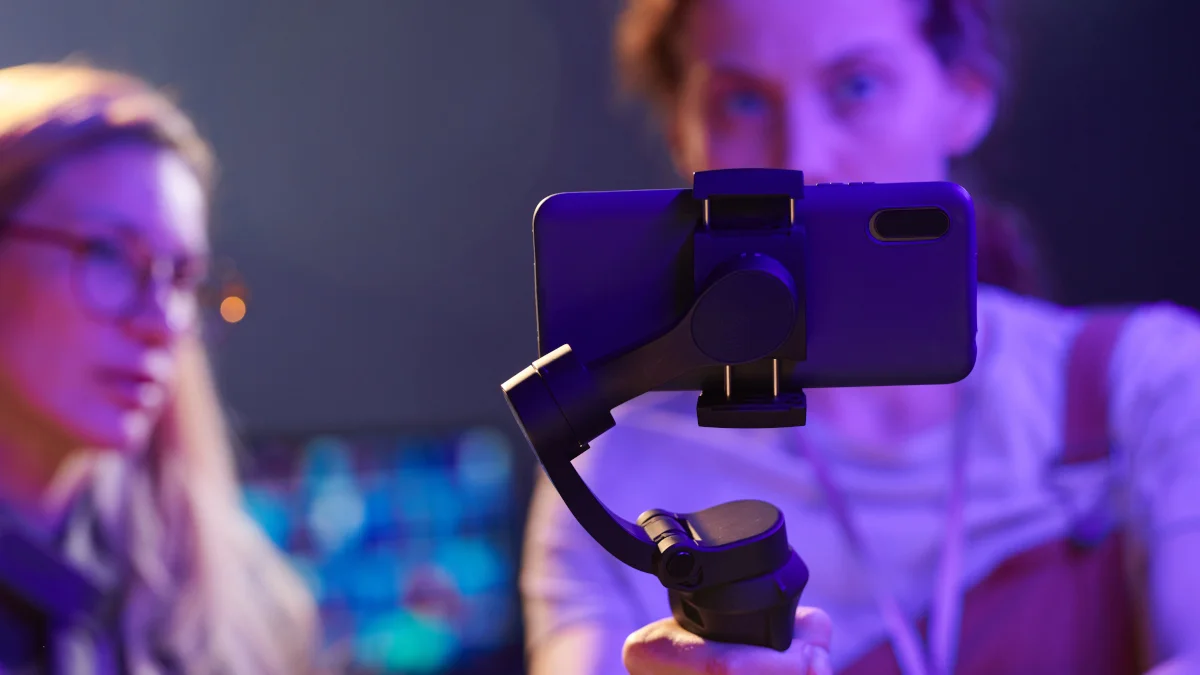
Handheld brings organic, human energy. Slight imperfections make it feel alive and present. Gimbals smooth out the shake while preserving that natural feel.
Handheld characteristics:
- Immediacy and realism (documentary, action, intimate drama)
- Emotional urgency or chaos
- The more zoomed in you are, the more shake becomes visible. Wide lenses forgive more movement.
Gimbal advantages:
- Floating, buttery smooth tracking shots
- Long walk and talk sequences
- Controlled handheld aesthetic without raw shake
Advanced and Signature Techniques
-
Reveal Shot
Any movement that gradually brings a new element or surprise into frame (subject starts off screen and enters through motion). -
Parallax Orbit Arc
Rotate slowly around the subject while keeping it centred.
Creates shifting layers. Foreground and background move at different speeds, adding depth and three dimensionality.
Works best with wide angle lenses; tighter focal lengths magnify shake. -
Subject Track Walk with
Move alongside the subject at matching speed (often profile or three quarter view).
Maintains consistent framing during motion; feels dynamic yet controlled. -
Dolly Zoom (Vertigo Effect)
Physically dolly backward while zooming in (or forward while zooming out).
Background appears to stretch or compress while subject size remains constant. Creates powerful sense of unease, disorientation, or psychological shift. -
Multi Axis Compound Moves
Combine movements for richer storytelling:- Push in while tilting up
- Truck left while pedestal up
- Orbit while slowly rising
These layered moves add complexity and emotional weight.
Practical Tips for Cinematic Results
- Shoot low to the ground and use foreground elements (branches, furniture, rain, dust) to create natural parallax and depth layers.
- Match speed to emotion: slow for tension or intimacy, faster for energy or action.
- Plan every move. Rehearse, mark start and end positions, test speed and framing.
- Less is often more. Subtle movement usually feels more cinematic than extravagant motion.
- Modern tools expand possibilities: affordable sliders, 3 axis gimbals, smartphone gimbals, and drones (aerial cranes).
Before You Move the Camera, Ask:
- What does this movement reveal or emphasise?
- Does it serve the emotion or advance the story?
- Is the move smooth, intentional, and motivated?
- Could a static shot or simpler move achieve the same (or better) result?
Mastering purposeful camera movement transforms average footage into something rhythmic, immersive, and emotionally resonant. Practise these fundamentals and your visual language will grow exponentially more expressive.
About the Author
Written by Neil Huyton. Sheffield-based web developer and creator. I build sites with JavaScript/TypeScript, shoot video, and fly drones. Sharing what I’ve learned along the way.